

Bullet Journal on a blank page: how to get full freedom in planning
When someone hears “bullet journal,” they immediately imagine evenly spaced dotted lines stretching from edge to edge. But in reality, the BuJo system was created for something else entirely—not for dotted paper—and thousands of people every day find out that a blank page gives far more freedom. This article is a practical guide for those who want to keep a bullet journal on clean paper: from theory to specific modules and step-by-step instructions.

What is Bullet Journal and why is it so popular
Bullet Journal— is a system for organizing life that American designer Ryder Carroll developed for himself back in childhood while trying to cope with a lack of attention. He published the method in 2013, and within a few years BuJo turned into a global movement with millions of followers.
The main idea is simple: one notebook instead of a dozen tools. A diary, planner, habit tracker, task list, a notebook for ideas—everything in one place, structured according to your own logic. No apps, no subscriptions, no dependence on Wi‑Fi.
The system is built on three key principles:
- Quick capture— any thought, task, or event is written down immediately, using minimal symbols (the so-called “bullets”).
- Reflection— every day, every week, and every month you review your notes, deciding what to keep, what to move, and what to delete.
- Migration— unfinished tasks don’t get lost; they’re consciously carried forward or canceled.
It’s exactly this flexibility that made BuJo so popular: the system adapts to the person, not the other way around. And that’s why a blank page—not dotted paper—is its natural environment.
The myth about dotted paper: where it came from and why it’s wrong
Instagram and Pinterest did their job: if you type “bullet journal” into the search, most results show notebooks with dots. Even the popular brand Leuchtturm1917 started releasing a special “Bullet Journal Edition” specifically with dotted paper. That’s where the misconception came from: BuJo = dots.
But Ryder Carroll himself, in his book “The Bullet Journal Method,” never says that you need dotted paper. He describes a system, not a specific paper format. The first followers of the method kept their BuJo in regular notebooks, in graph notebooks, and on blank pages—and the system worked just as well.
Dotted paper appeared as a compromise: it provides orientation for drawing lines, but doesn’t stand out as much as grid paper or a ruler does. For people who pick up a notebook for the first time and don’t know how to draw a straight line, dots are a convenient hint. But it’s a crutch, not a necessity.
Moreover, for an experienced BuJo user, dotted paper often becomes a limitation: the grid dictates the sizes of blocks, ties you to a certain step, and gets in the way of drawing non-standard modules. A blank page has none of these limitations.
Advantages of a blank page for Bullet Journal
Complete layout freedom
On dotted paper, the distance between dots is usually 5 mm. That means all your blocks, columns, and tables will be multiples of 5 mm. On a blank page, you decide: you can have a wide daily log on the left and a narrow task list on the right—no problem. Want a large column for Monday and a small one for Sunday? Easy.
Custom modules of any size
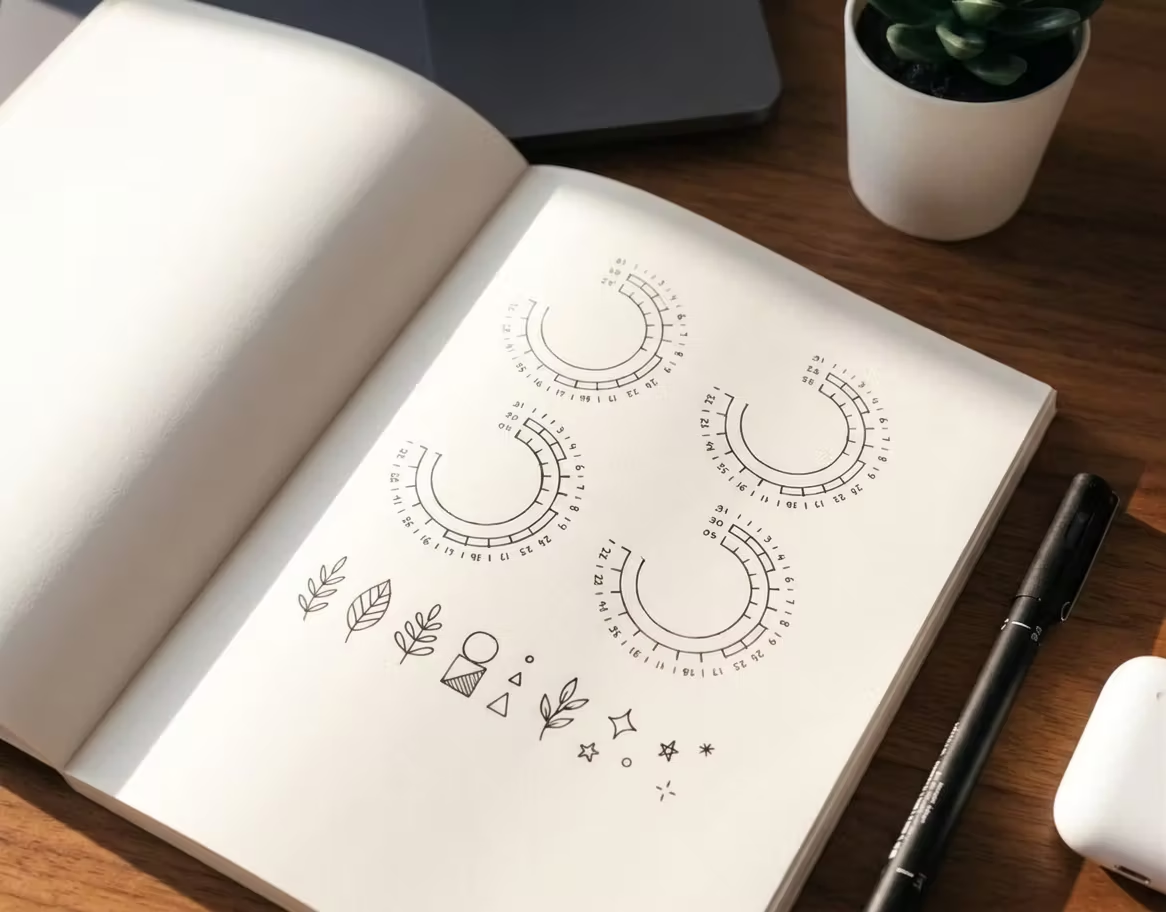
Dotted paper works reasonably well for standard spreads. But if you want to draw a mood tracker in the form of a mandala, place a habit tracker in a circle, or make a future log with twelve uneven sections, the grid will get in the way. A blank page has no such limitations.
Clarity of perception
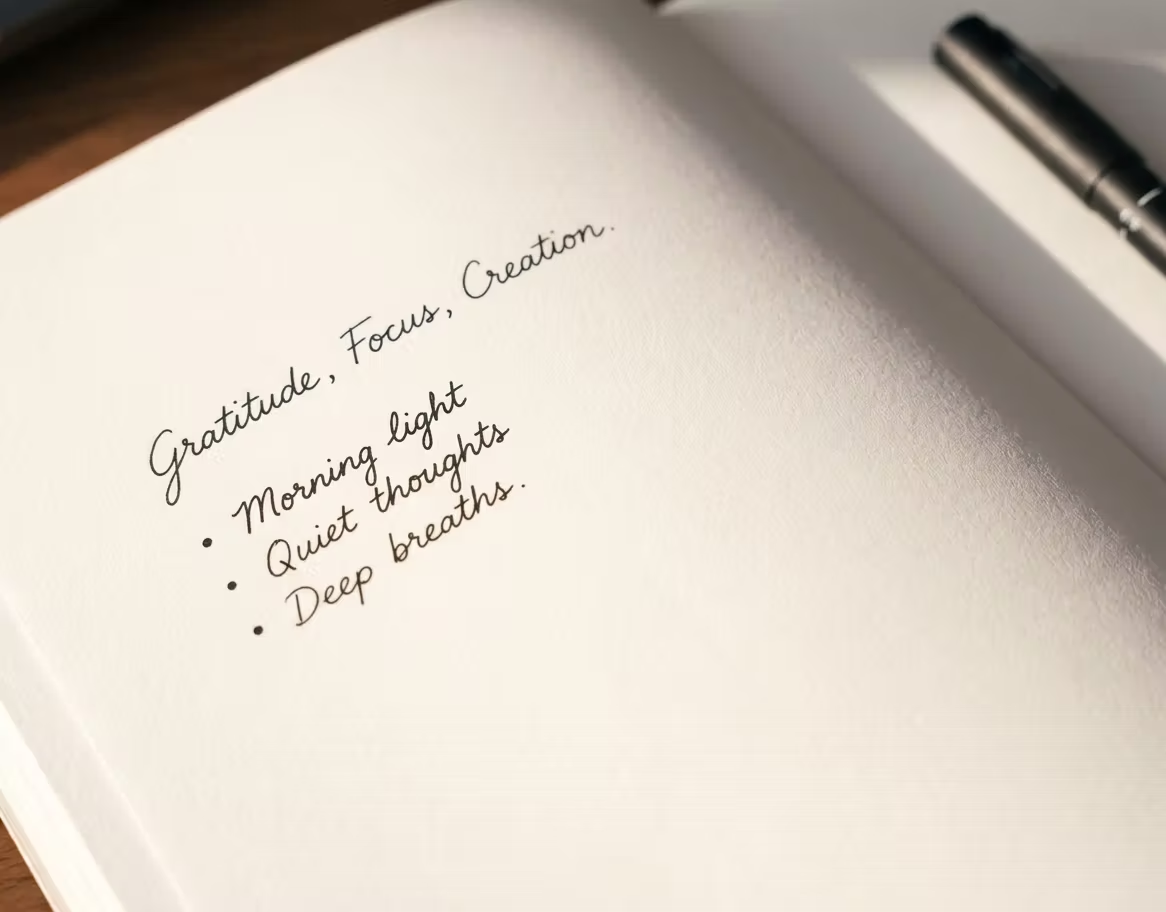
When a page is already “occupied” by a small grid, your brain subconsciously perceives it as filled space. A clean white page is psychologically perceived as open, empty, ready for any idea. This isn’t mysticism—it’s simply how our perception works.
No conflict with your writing style
People write differently: some write small, some in large letters, some with a slant. A dotted or lined grid often conflicts with an individual handwriting style. A blank page adapts to any style without extra “noise.”
How to draw your own grid on a blank page: step-by-step instructions
If you need straight lines or a table, it’s easy to draw them yourself. Here are a few proven methods.
Method 1: Pencil and ruler
- Use a pencil with hardness H or 2H—it leaves a thin, light line.
- Measure the required spacing with a ruler (for example, 6 mm for lines or 5 mm for a table).
- Draw horizontal or vertical lines across the entire page—or only where you need them.
- Write with a pen over the pencil lines.
- After filling the page, carefully erase the pencil with an eraser.
Result: clean writing with no visible grid, but with perfectly straight lines. This method is used by calligraphers—and it works great for BuJo.
Method 2: Tracing sheet/template
- Print or draw a grid or lined template on thick paper—in Manuscript it comes as part of the set, by the way.
- Place the template under the notebook page.
- If the paper is thin enough (80–90 g/m²), the lines will show through very easily—though you can also show through paper up to 170 g/m², but it’s harder.
- Write using the visible lines of the template as your guide.
This method is especially convenient if you often draw tables of the same size—for example, a habit tracker every month. Make one template—use it for years.
Method 3: DIY dot grid
- Measure dots along the edges of the page with a 4.5–5 mm step from top and bottom.
- Connect the corresponding dots with light horizontal guide strokes.
- Do the same for the vertical lines.
- At the intersections of the horizontal and vertical lines, place a dot with a thin pencil.
Takes 5–7 minutes per page and gives exactly the same result as a store-bought dotted notebook—only with any spacing you need.
Method 4: No grid at all
The most radical—and most often underestimated—approach: simply write on a blank page without any lines. Most people who practice BuJo for more than 3–6 months gradually give up the grid altogether. The lines become straight enough on their own—your hand adapts. And the freedom that a completely blank page gives is worth a few weeks of adjustment.
Practical BuJo modules on a blank page
Here’s how to build each of the main Bullet Journal modules without a pre-made grid—just with a pencil, pen, and ruler (or even without it).
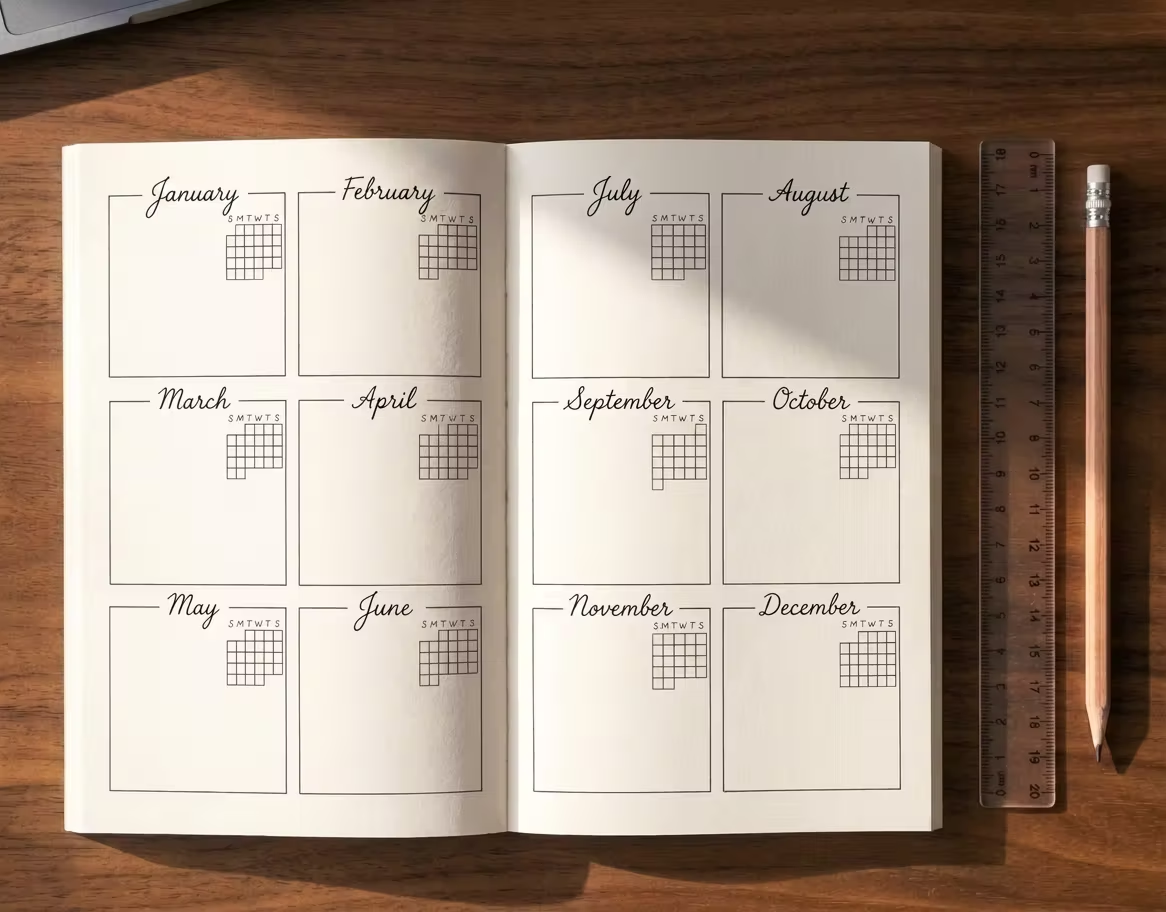
Future Log — annual plan
Future Log is an overview of the next 6–12 months on a single spread. On blank paper, it’s even more convenient to build than on dotted paper.
How to build:
- Divide the spread in half with a vertical line (or into three parts for 12 months).
- Divide each half with horizontal lines into 6 equal sections.
- Label each section with the month name.
- In each section, write important dates, events, and deadlines.
On a blank page, the sections don’t have to be perfectly equal—for example, a larger block for a busy month and a smaller one for a calm month. Dotted paper doesn’t give you that flexibility.
Monthly Log — monthly overview
The Monthly Log traditionally takes up one spread: on the left— a list of the days of the month with important events, on the right— tasks for the month.
On a blank page:
- On the left, draw a vertical column with the day numbers (1–30/31). Next to it, write the first letter of the day of the week (M, T, W, T, F, S, S).
- Opposite each number, write a short note of the event or an important meeting.
- On the right— a vertical list of tasks and goals for the month, with each item marked with a bullet symbol.
No tie to the grid step: the column with numbers can be narrow, while the notes area can be wide. You decide the proportions.
Daily Log — daily entries
Daily Log is the heart of the system. It isn’t a diary in the traditional sense, but an “in-the-moment” day log: tasks, notes, events.
Carroll’s classic symbol system:
- • (dot) — a task
- – (dash) — a note or thought
- ○ (circle) — an event or meeting
- ! — an important idea
- → — task migrated forward
- × — task canceled or no longer relevant
- ∗ — priority
On a blank page, these symbols look clearer and more noticeable than on dotted paper, where they get lost in the background grid.
Habit Tracker — habit tracker
Habit Tracker is one of the most popular Bullet Journal modules. Usually it’s a table: a list of habits on the left, the days of the month across the top, and cells for checkmarks at the intersections.
How to build on a blank page:
- Draw a horizontal line at the top of the page.
- Under it, add a vertical list of habits (charging, reading, water, meditation, etc.).
- Along the top line, write numbers from 1 to 31 (or only workdays if you track only those).
- At the intersections, draw small squares or simply leave space for a mark.
On a blank page, you’re not limited by the grid step: you can make a tracker for 5 habits or for 20, with big cells or small ones. Some BuJo users draw the tracker as a circle or a sun—and on blank paper it’s much easier than on dotted paper.
Mood Tracker — mood tracker
Mood Tracker is a visual journal of your emotional state. The classic version: 30–31 squares, each colored according to the mood of the day (blue—calm, yellow—joy, gray—fatigue, red—stress).
Options for a blank page:
- Classic table — 31 squares in a row or in several rows, each colored with a marker.
- Circle of the year — 365 sectors in a circle, one sector per day. It turns into a beautiful “mood mandala” at the end of the year.
- Cloud of thoughts — free-form: each day a small cloud silhouette, colored according to the mood.
- Petal diagram — for tracking several parameters (energy, productivity, sociability) at the same time.
None of these formats fit into a dotted grid without compromises. On a blank page—please.
Tools for BuJo on a blank page
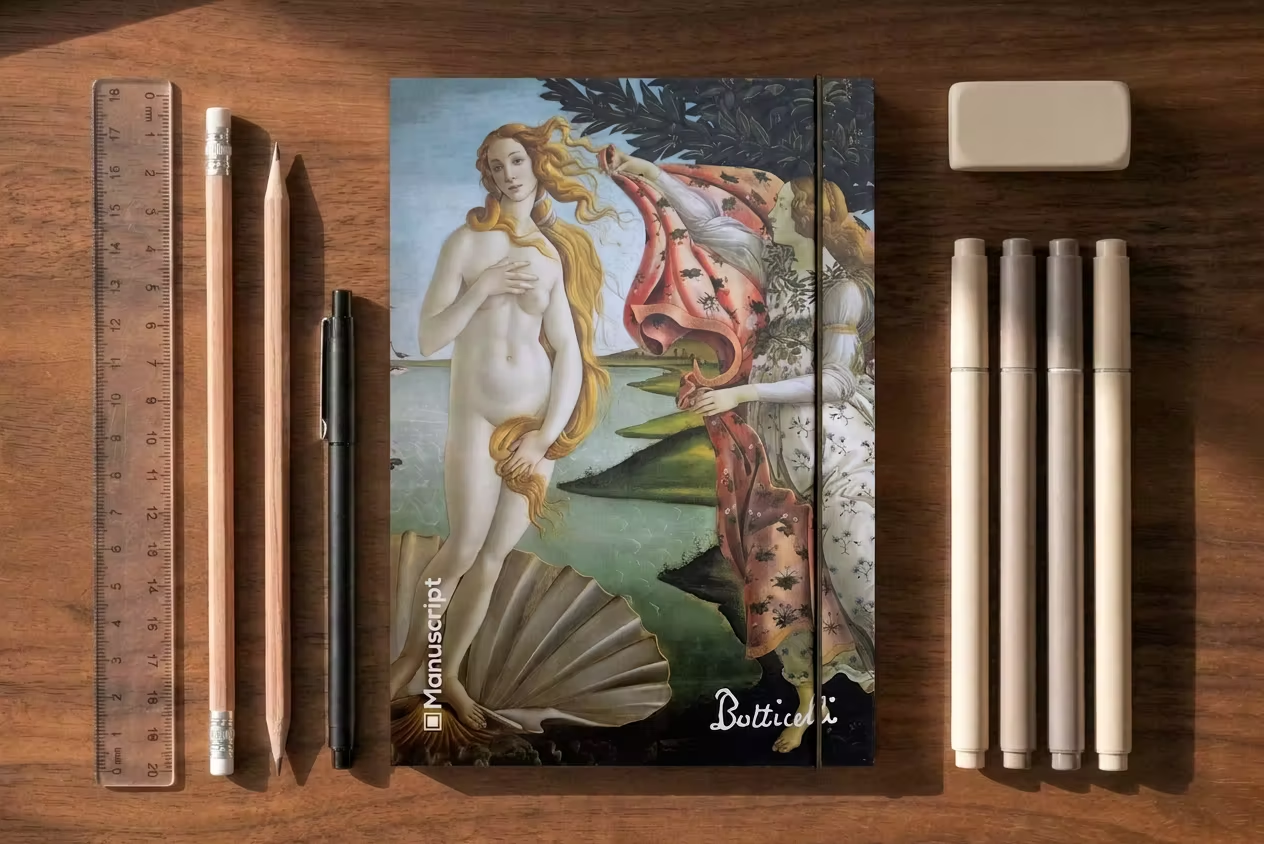
To keep a Bullet Journal on blank paper, you don’t need a huge set of tools. Here’s the minimum and an extended kit.
Minimum set
- H or 2H pencil — for preliminary marking that you then erase. A hard pencil leaves a thin line and is easy to erase.
- Ruler 15–20 cm — for straight lines. A transparent ruler is more convenient—you can see what’s underneath.
- Pen with a fine tip (0.3–0.5 mm) — for main entries. Micron, Pigma Micron, Staedtler are classics.
- Eraser — for removing pencil markings.
Extended set
- Rapidograph or fineliner — for headings and crisp lines. Liners in 0.1, 0.3, and 0.5 mm give different stroke thicknesses.
- Water-based markers — for coloring in habit tracker and mood tracker cells. Important: they should not bleed through to the back.
- Color pens or stabilos — for color-coding.
- Stencil for circles — if you like non-standard modules.
- Stickers and washi tape — for visual emphasis.
Why Manuscript is perfect for BuJo on a blank page
Choosing paper for a Bullet Journal is not a secondary question. Poor paper quality can ruin the whole experience: markers bleed through, pens tear the fibers, and pages won’t lie flat. That’s why Manuscript notebooks became the choice among budget BuJoers.
Thick paper—markers don’t bleed through
Manuscript notebooks are made from thick paper that holds ink well and doesn’t let it seep through to the other side. This is critical for a habit tracker and mood tracker, where you color entire cells with a marker. On cheap paper, a marker “goes through” and ruins the page on the back. On Manuscript paper—no.
Opens flat—convenient for drawing modules
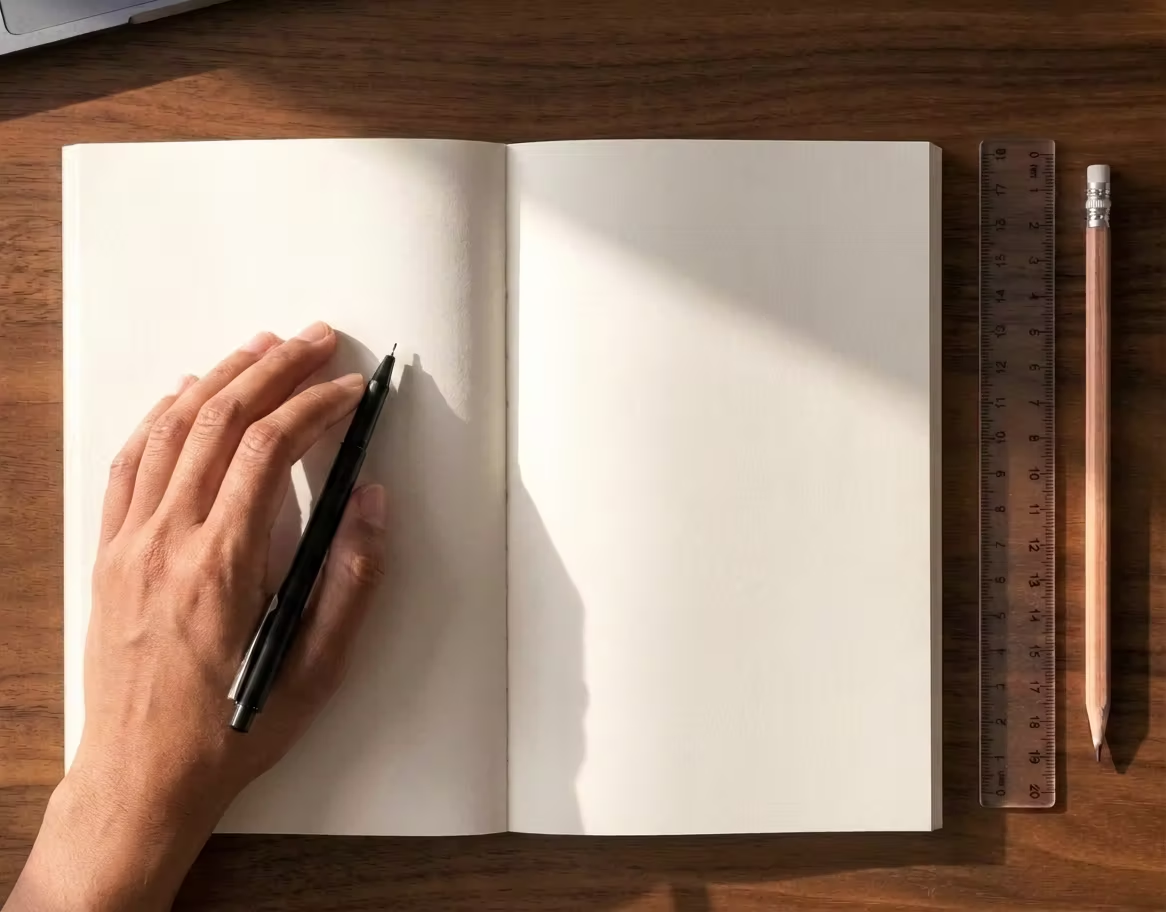
Manuscript notebooks open flat at 180° and lie completely flat. This is essential for BuJo: when a notebook “closes” while you work, drawing straight lines and tables becomes real suffering. With Manuscript, you always work on an even surface—so the ruler slides straight, and your hand doesn’t get tired holding the pages open.
A5 format is optimal for BuJo
A5 (148 × 210 mm) is the gold standard for a Bullet Journal. Enough space for elaborate modules and tables, but compact for daily carry in your bag. Manuscript notebooks are made in this exact format.
Made in Ukraine
Manuscript is a Ukrainian brand. By buying a Manuscript notebook, you support domestic production and get quality that doesn’t fall short of European equivalents. For the BuJo community, where conscious choice matters, this also makes a difference.
Clean pages are a fundamental position
Manuscript is sketchbooks and notebooks with blank pages. No dots, lines, or grid. A clean white page that’s waiting for your system doesn’t impose anyone else’s. That’s the kind of paper that best unlocks the potential of Bullet Journal.
Real examples and inspiration: how people keep BuJo on blank pages
The BuJo community has long moved beyond the standard dotted notebook. Here are a few real approaches that people use on blank paper.
Minimalist BuJo
Some users don’t use any tables or trackers at all. Just the date, a few lines of text, and bullet symbols. Such a BuJo takes 2–3 lines per day and looks like a regular diary. A blank page is perfect here: nothing distracts.
Artistic BuJo
Some BuJo users turn their notebook into a real artist’s diary: each page is a mix of text, drawings, watercolor splashes, and collages. On dotted paper, dots “conflict” with the artwork. On blank paper, the page is truly clean.
Structured BuJo
Those who value the system more than aesthetics draw clear tables and blocks, label sections, and color-code entries. On a blank page—with a ruler and rapidograph—it results in a neat, almost printed structure—and no grid gets in the way of accurate lines.
Hybrid BuJo
A popular approach: a daily log on blank pages + template inserts for monthly modules. Every day—free; for trackers— a ruler and pencil markings. The best balance of freedom and structure.
How to start: first steps for beginners
If you’ve never kept a BuJo and want to start on a blank page, here’s a minimal starter plan.
- Number your pages. This is the only mandatory requirement of BuJo. Without numbering, the index won’t work.
- Create an Index on the first 2–4 pages. Leave them empty—you’ll fill in the index as you add new sections.
- Draw the Future Log. Divide the spread into 6 sections, and label the months. Write down everything important that you already know for the coming months.
- Draw the Monthly Log for the current month. List of dates on the left, tasks on the right.
- Start your Daily Log. Today’s date, task list, notes. That’s it.
The first month is the hardest: you want to do everything perfectly, but it turns out “not quite right.” That’s normal. BuJo is a living document, not a museum exhibit. Allow yourself to make mistakes, cross things out, and redo them. A blank page is made for that.
Conclusion
Bullet Journal on a blank page is not a compromise and not a “second-rate” option. It’s a return to the roots of the method, where paper is a tool, not a dictator. A blank page gives you what dotted paper can’t: absolute freedom of layout, the ability to use any format, and the absence of background “grid noise.”
Yes, at first it may be inconvenient to draw straight lines without a guide. But after just a few weeks, you’ll notice your hand getting steadier, your modules becoming more precise, and your notebook becoming truly yours. Not template-like, not like hundreds of others—yours.
If you’re ready to try Bullet Journal on a blank page, Manuscript notebooks are the best place to start. Thick paper, A5 format, opens flat at 180° and lies flat—everything you need for convenient work. And no unnecessary grid that would limit your system.