

The first thing people notice when they pick up a Manuscript is the cover. The painting. Sometimes familiar, sometimes new. And almost always — a question: “Why is the logo a black square?” We explain.
A nod to Kazimir Malevich’s “Black Square”: why we chose this symbol
Kazimir Malevich’s “Black Square,” painted in 1915, is one of the best-known and most controversial works in 20th-century art. It’s not just a painting. It’s a symbol: the moment when the artist rejected depicting the real world and left only form and color as independent values.
For us, the black square in the Manuscript logo is a metaphor for a blank page. An empty sheet before the first stroke. Space where nothing is there yet — and therefore anything is possible. Anyone who opens a new sketchbook feels it: a slight tremble before the first line on white (or cream) paper.

Malevich showed that art begins with simplicity. We wanted the Manuscript logo to say the same thing.
A sketchbook as an extension of art, not just a notebook
Most sketchbook manufacturers sell an instrument. We sell space for thought.
The difference is this: when you open a regular notebook, you think about the task. When you open Manuscript, you think about what you want to create. A cover with a painting sets the gaze. Good paper invites you to begin. An open binding removes physical barriers.
A sketchbook is not just a place to write things down. It’s where your thoughts become visible. And it’s important to us that this object is beautiful in itself — before you draw anything on it.
Paintings by great masters on the covers: how we select them and why it matters
Vincent van Gogh, Cézanne, Klimt, Bruegel, Hae(z)sum, Bosch — on Manuscript covers, you’ll find works by artists whose names have already become part of cultural code. But we don’t choose them based on popularity. We choose based on how they look in your hands, in an open spread, after printing, and across other parameters.
Munch, Hokusai, Vrubel, Mondrian, Monet — and many other paintings didn’t fit one of the many criteria.
The basic criteria are simple: the painting must be strong in details and look great on the front cover. The A5 Plus cover is small. If a fragment doesn’t “read” on its own or, as often happens, more attention goes to the left part of the painting’s narrative without knowing the whole canvas, then it won’t make it into the sketchbook. That’s why we sometimes take not the central storyline, but a slightly adapted version. And sometimes the paintings aren’t all rectangular.
The result is that every Manuscript cover looks like a small reproduction you wouldn’t be ashamed to put on a shelf next to art books or place in the background — and it can inspire you in the moment of our fleeting everyday life.
How your favorite painting on the cover affects your motivation to open your sketchbook every day
It might seem like a small thing, but the psychology is simple. We more often pick up beautiful things. A sketchbook that feels nice to take off the wall opens more often than one that simply sits on the table with a gray cover facing up.
Many of our customers say they chose Manuscript because of a specific cover. Then they bought the next one — already for a different painting. That’s how a collection forms, where each sketchbook is not only an archive of work, but also an aesthetic object.
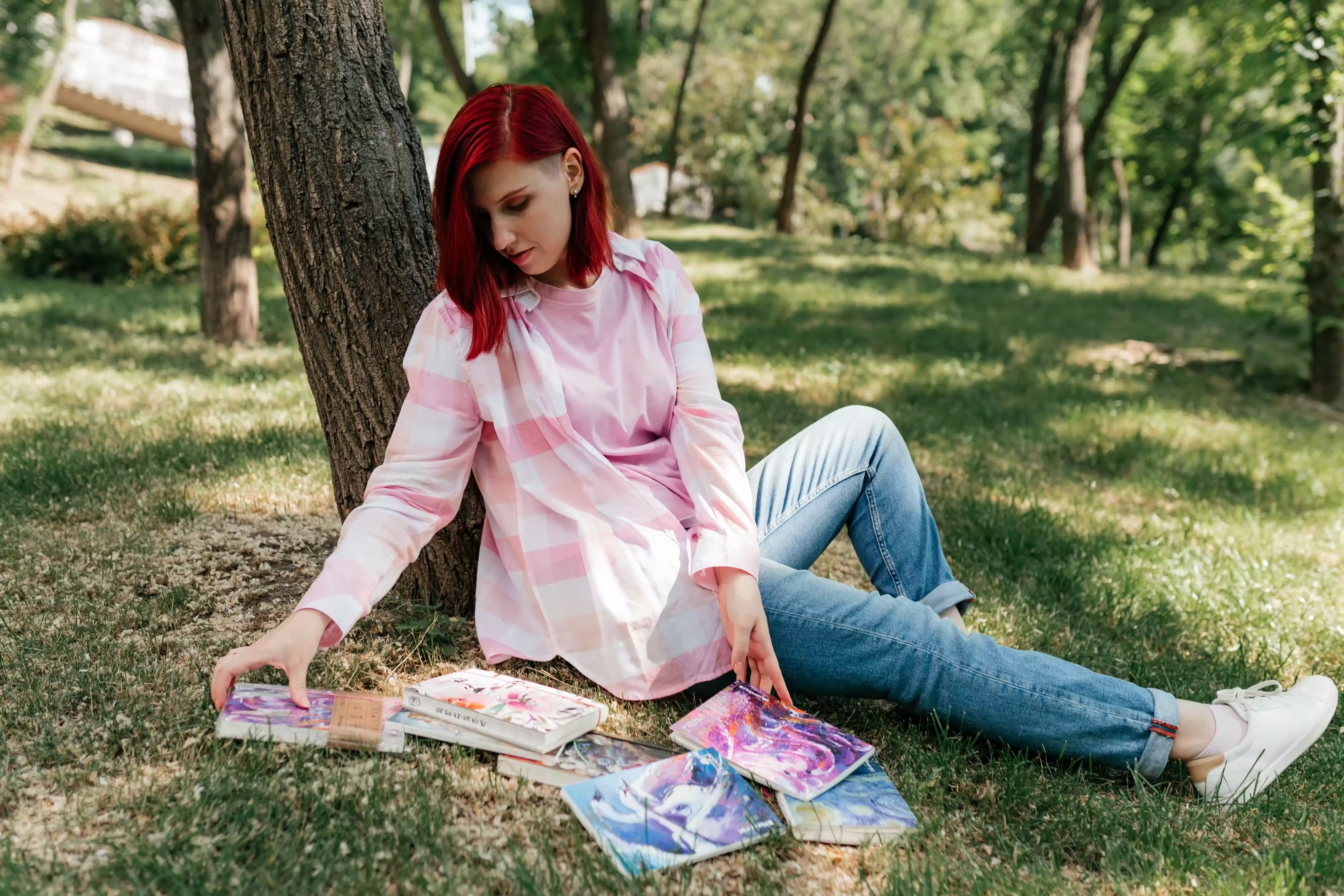
And here’s another effect: when you see on the cover a work by an artist you respect, you automatically think about the fact that he also started from a blank page. That motivates you.
Manuscript as an aesthetic object: combining function and beauty
The Japanese have a word “mingei” — the beauty of everyday objects made by hand for daily use. A mug that feels good to hold. A knife that lies in your hand, balanced. A sketchbook you want to open.
Manuscript is not a luxury product and not an “art object for a shelf.” It’s a tool that’s convenient to use every day — and that is also beautiful. An open binding, Swedish paper 150 g/m², a hard cover with a painting, an elastic band, a bookmark — every detail here has a function. And together, everything looks like a sketchbook you want to display, not hide in your backpack.