

History, math, and psychology: why the A5 format is the ideal notebook size
Imagine this: you’re standing in front of a shelf full of notebooks. Next to it is A4 (too big, won’t fit in your bag), A6 (too small, your fingers don’t fit), Pocket (tiny). And then your eyes land on A5. 148 × 210 mm. You pick it up—and you immediately understand: this is it.
Choosing a notebook format is not a small thing. It determines whether you’ll take it with you, use it every day, and whether you’ll feel satisfaction from the process. Too small—there’s no room for your thoughts. Too big—it stays at home. That’s why A5 has remained the most popular format among artists, designers, journalists, and everyone who thinks with their hands for decades.
But where did this format come from? Why exactly 148 × 210? And why has the whole civilized world (except for two countries) switched to it long ago? Let’s break it down—from the beginning, from math, and a little from history.
How the A5 standard came to be: from Lichtenberg to ISO
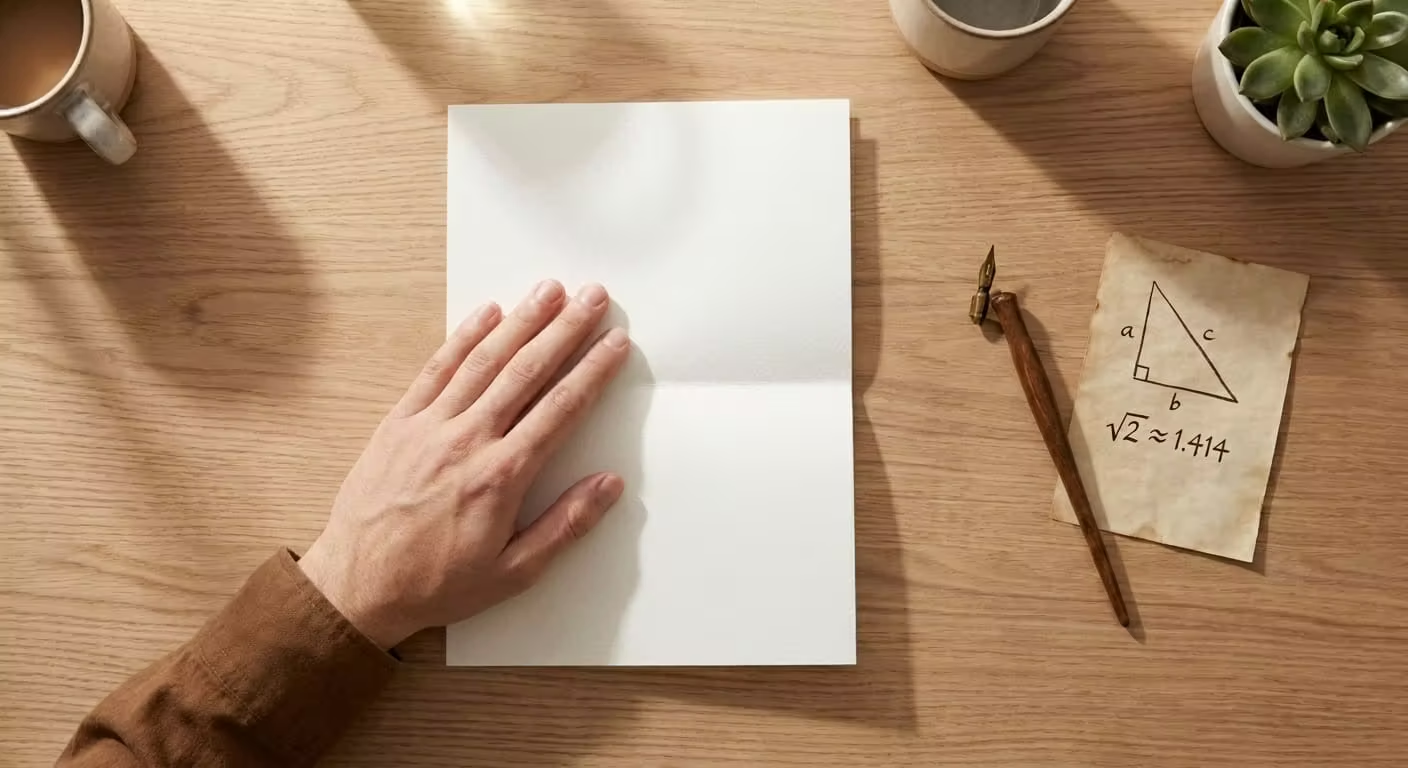
The history of the A5 format doesn’t begin in an office or in paper manufacturing—it begins in the mind of a brilliant German physicist. In 1786, Georg Christoph Lichtenberg, a professor at the University of Göttingen, wrote a letter to a friend in which he described the mathematically ideal proportions of a sheet of paper: when folded in half, it produces a smaller sheet with the same proportions, again.
That doesn’t sound revolutionary—but in reality, it’s brilliantly simple. If a sheet’s side ratio is 1:√2 (approximately 1:1.4142), then when you fold it in half, the shorter side becomes the longer side, and the longer side splits into two—so the proportion remains. Forever.
Lichtenberg died without seeing the practical realization of his idea. Only more than a hundred years later—in 1914—WilhElm Ostwald, a chemist and Nobel Prize laureate, proposed to introduce this principle as the single international standard for paper. In 1922, Germany became the first country to officially adopt DIN 476—the predecessor of today’s ISO 216. After World War II, the standard spread to most countries around the world, and in 1975 it was adopted as an international standard by ISO.
Today, ISO 216 is in use in 160+ countries. It’s one of the most universal industrial standards in human history.
Mathematical elegance: why 1:√2 is brilliant
At the heart of the entire A series is a single sheet—A0. Its area is exactly 1 square meter. Dimensions—841 × 1189 mm. This isn’t random: the area of A0 was chosen so that the whole series has a clear physical meaning (printing, paper weight per square meter, etc.).
Next, we simply divide it in half:
- A0: 841 × 1189 mm (1 m²)
- A1: 594 × 841 mm
- A2: 420 × 594 mm
- A3: 297 × 420 mm
- A4: 210 × 297 mm
- A5: 148 × 210 mm
- A6: 105 × 148 mm
Notice this: the long side of A5 (210 mm) equals the short side of A4 (210 mm). And the short side of A5 (148 mm) is exactly half of the long side of A4 (297 mm / 2 ≈ 148.5 mm). This mathematical consistency makes working with documents incredibly convenient: two A5 sheets fit perfectly into one A4, four into an A3, and so on.
Three facts about ISO 216 that will surprise you
The USA and Canada—paper nonconformity islands
Among all developed countries, only the USA and Canada still haven’t adopted ISO 216. The American Letter standard (215.9 × 279.4 mm) and the legal format (215.9 × 355.6 mm) don’t have that magical 1:√2 proportion—so you can’t simply fold them in half and get the same format again. This “island” standard is a legacy of the colonial era, and even NASA, despite recognizing its non-optimal nature, is forced to adapt all international documents.
The A5 format was never designed for notebooks
The ISO 216 standard was developed for administrative documents, printing, and office paperwork—not for sketchbooks and journals. But the format’s mathematical elegance turned out to be so convenient for a person that artists, writers, and designers “appropriated” A5 for themselves. Today, it’s a de facto standard for creative notebooks around the world.
The area of A0 is exactly 1 m²: not a coincidence—it was designed that way
When the standard was developed, the area of the base A0 sheet was set intentionally to exactly 1 m²—to simplify the calculation of paper density. If paper is “80 g/m²,” then an A0 sheet weighs exactly 80 grams. An A4 sheet—one sixteenth of A0—weighs 5 grams. A5—one thirty-second—2.5 grams. Simple math with no adjustment coefficients.
Comparing formats: where A5 lives among others
To understand why A5 occupies the golden middle, let’s look at all the popular formats side by side:
| Format | Size (mm) | Sheet area | Characteristic |
|---|---|---|---|
| A4 | 210 × 297 | 624 cm² | An office standard: big and convenient at a desk, inconvenient on the go |
| Moleskine Classic Large | 130 × 210 | 273 cm² | Narrower than A5—an in-house non-standard brand format |
| A5 | 148 × 210 | 311 cm² | The golden middle: fits in a bag, enough for work |
| B5 | 176 × 250 | 440 cm² | Between A4 and A5—rarely found, doesn’t fit everywhere |
| A6 | 105 × 148 | 155 cm² | Pocket-sized—convenient for notes, tight for drawing |
| Pocket / Field Notes | ~90 × 140 | ~126 cm² | Minimalist—only for short notes |
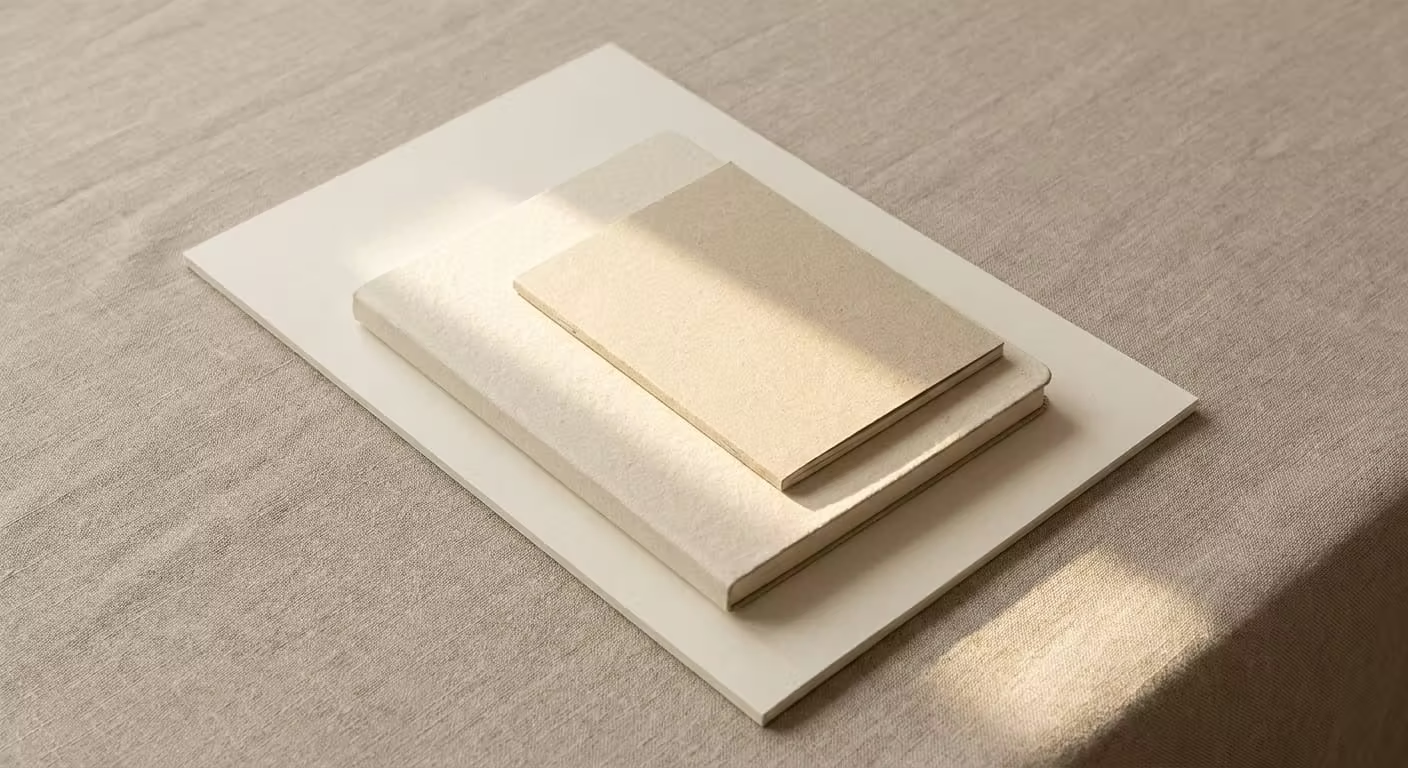
A5 has exactly twice the area of A6—and half the area of A4. This isn’t just math: you can feel it physically when you hold a notebook in your hands.
Who A5 is perfect for: specific scenarios
Artists and sketchers
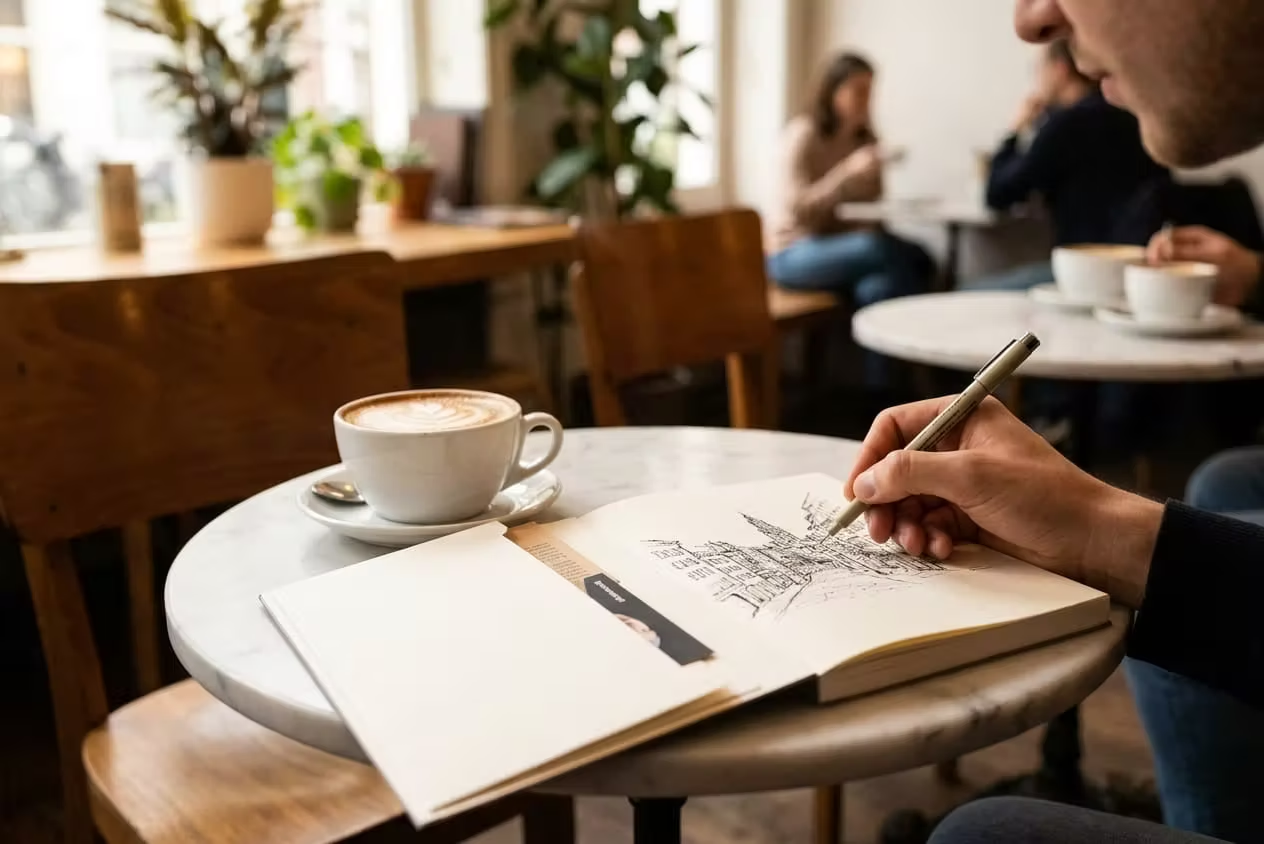
A5 is the classic format for plein air drawing. The sheet is large enough to draw a detailed cityscape or a portrait with extra notes, and at the same time compact enough to hold the notebook with one hand while you draw with the other. Sketchers who go out to plein air usually bring A5—A4 is too heavy and inconvenient on the street, and A6 is too cramped for normal work with details.
Bullet journal and planning
The BuJo community has long chosen A5 as its standard. On an A5 spread, a weekly schedule fits perfectly: on the left, a habit tracker or a task list; on the right, daily notes. Compared to A6, A5 offers significantly more space for creative spreads, illustrations, and decoration—exactly what bullet journal lovers value in their method.
Journalists and researchers
A field journalist or researcher conducting interviews needs a notebook that: (a) is easy to hold in one hand, (b) allows enough notes, and (c) is convenient to flip through. A5 meets all three criteria. An A5 page holds roughly 25–30 lines of medium-sized text. Enough for a detailed note or several quotes with context.
Students and studying
For students, A4 is lecture notes, printed handouts, and diagrams. A5 is a personal working notebook: a place for your own thoughts, diagrams for understanding, taking lecture notes in a free form. It fits in any backpack and sits on the desk next to your textbook without taking up half the table.
Designers and illustrators
For quick sketches, brainstorming, and concepts, A5 is the ideal size. There’s enough room to draw several layout options on a single sheet. Not so big that every sketch takes up an entire page—and not so small that details get lost.
A5 and mobility: why size matters on the move
We live in an era of mobility. Most of us spend part of the day outside the home or office—on public transport, in cafés, coworking spaces, and parks. A notebook that stays on a table and doesn’t go with you is almost useless.
A5 (148 × 210 mm) fits:
- in the side pocket of most backpacks
- in a tote bag or a sturdy women’s bag vertically
- in the inside pocket of a large coat or jacket
- in any small city backpack
At the same time, A5 is significantly more convenient on public transport than A4: you don’t have to hold it with two hands, it doesn’t tip over onto the armrest, and it doesn’t get in your neighbor’s way.
For comparison: A4 (210 × 297 mm) won’t fit vertically in most bags, and if you put it horizontally it takes up the entire space. A6 and Pocket are too small for comfortable work with text and images. A5 is the only format that fits and still provides enough space for full-fledged work.

The psychology of size: how a sheet affects you
This might sound strange, but the size of a sheet really changes the way you think and what you draw or write. Research in the psychology of creativity shows: a large blank page creates “blank-space pressure”—especially for perfectionists. A smaller page, on the other hand, lowers the threshold: “It’s just a note, not a masterpiece.”
A5 is in the perfect spot. It’s big enough to be taken seriously—you won’t just write shopping lists on it. But it’s small enough not to scare you: on A5 you can start without fear of “spoiling” the page.
Also, the size affects your writing and drawing style. On A4, your hand moves more—so you’re tempted to “stretch” your thought. On A5, thoughts naturally become more compact: you learn to be more concise, more precise, more expressive. Japanese calligraphers have known this effect for a long time—less space requires more attention to every stroke.
Psychologist Adam Alter, in his book “Irresistible,” describes a phenomenon that applies to notebooks as well: when a tool matches the scale of the task, we feel more engaged and more satisfied by the process. A5 is a format that “feels right” for most creative tasks.
Practical tips: how to use A5 as effectively as possible
Use the spread as a single working unit
An open A5 is a spread of 296 × 210 mm, meaning it’s an A4. Plan pages in pairs: on the left—context (a list, a task, a source), on the right—development (notes, a sketch, thoughts). This structure helps you not to “lose” information between work sessions.
Label sections with color or bookmarks
On A5 it’s easy to create a few “zones”—for example, the first 30 pages for work notes, the next 30 for sketches, and the last 20 for ideas and lists. Sticker bookmarks or a colored page edge will make navigation instant.
Carry it with you all the time—and it will become a habit
The main advantage of A5 over A4 is that it goes with you. Put it in your bag and carry it every day for two weeks. After a week, you’ll notice you started writing twice as much—just because the tool is right there. The habit of capturing thoughts is formed when there’s no obstacle between the thought and the paper.
Don’t be afraid of “imperfect” pages
A5 isn’t a museum exhibit. Scribble, cross things out, paste in tickets and postcards, write at an angle. These “alive” pages—after a year—will become the most valuable ones: proof of how you thought and what you felt.
Why Manuscript A5 Plus is the best implementation of this format
The A5 format is just a frame. Inside that frame, you can have very different experiences—depending on paper quality, binding type, and how the notebook lies in your hand.
The sketchbook Manuscript A5 Plus answers the question “what an ideal A5 notebook should be like”:
- 150 g/m² paper—dense, with no show-through. It doesn’t fear markers, ink, or one-layer watercolor. The sheet feels pleasant to the touch: it has a light texture that provides “grip” with a pencil and pen.
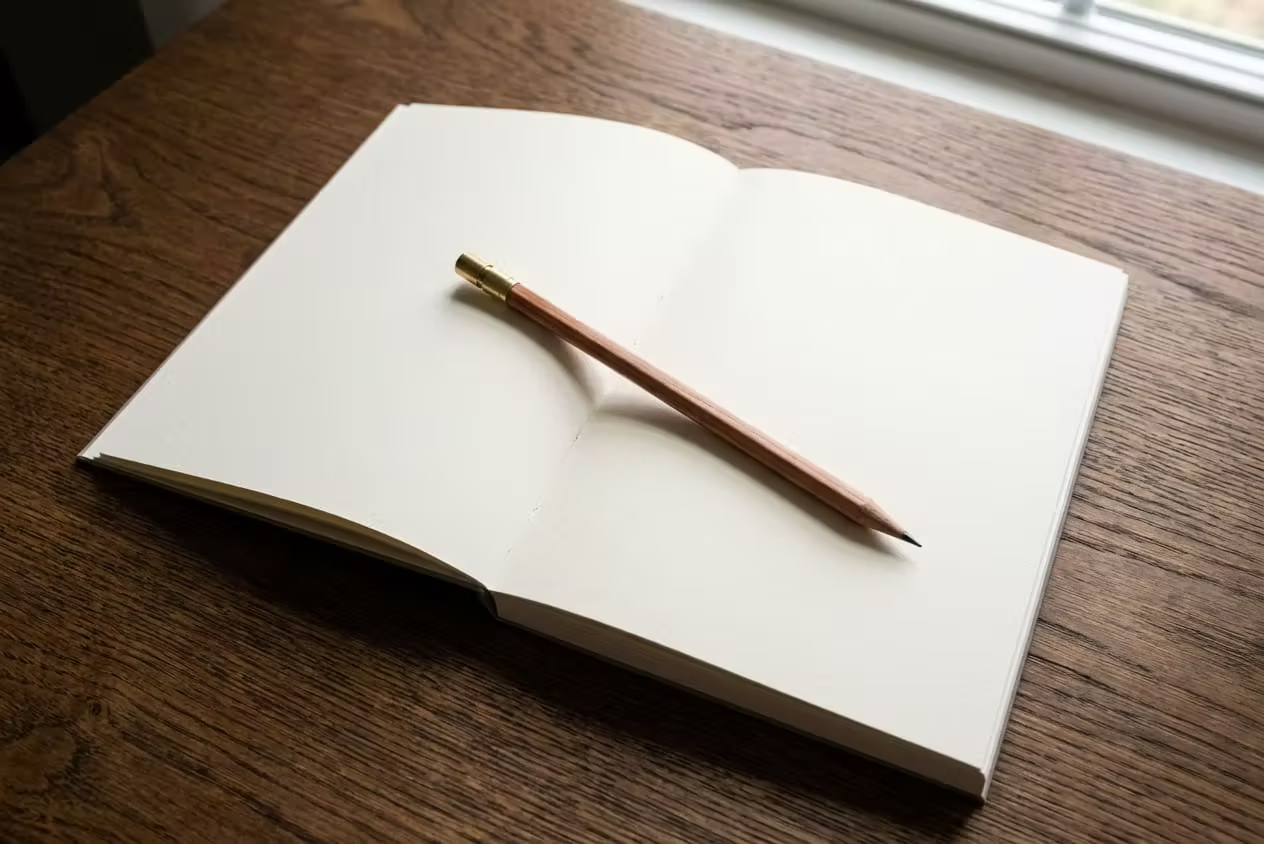
- 180° binding—the notebook opens fully flat. No fingers holding down pages. No “hills” in the middle of the spread. This is critical for sketching and bullet journaling.
- Clean pages—no grid, no lines, no restrictions. A clean page gives maximum freedom: you can write, draw, build diagrams, and combine text and images the way you need—not the way the ruled lines allow.
- Made in Ukraine—each notebook is made here, with direct quality control, not handed off to intermediaries.
Manuscript A5 Plus isn’t just an A5-format notebook. It’s the implementation of this format without compromises: the right paper, the right binding, the right size.
Conclusion: A5 is a choice you won’t regret
From Georg Lichtenberg, who described the ideal paper proportion in his 1786 letter, to ISO 216, which covers 160 countries—the A5 format has taken a long journey. But the reason for its popularity hasn’t changed: it’s mathematically perfect and humanly convenient at the same time.
A5 fits in your bag and doesn’t take over the whole desk. It’s big enough for serious work—and small enough not to intimidate you with a blank page. It suits an artist, a journalist, a student, and a planner. It works in the metro, in cafés, on plein air outings, and at your work desk.
If you haven’t tried keeping an A5 notebook every day yet—start. And if you’re looking for the best entry point, Manuscript A5 Plus is exactly where you should begin.